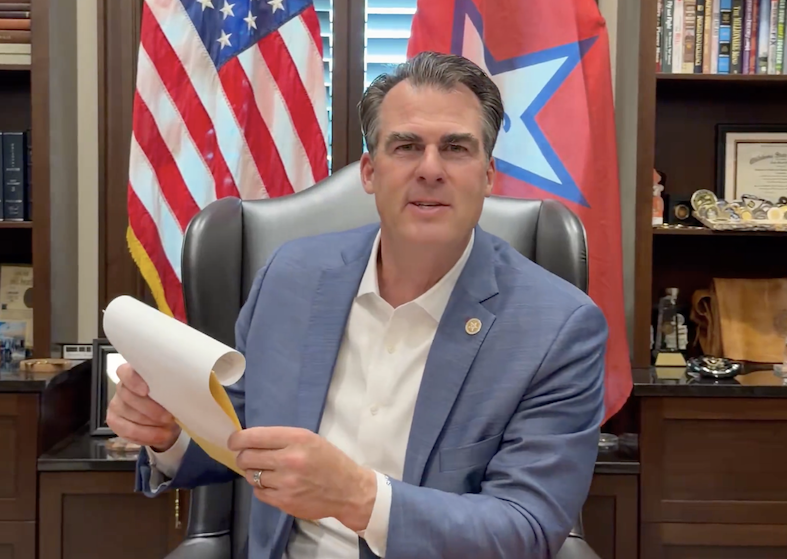
Oklahoma – Governor Kevin Stitt signed a wide-ranging package of legislation into law while issuing vetoes on four bills, according to an official release outlining final action on multiple measures affecting education, public safety, health care, transportation, and state governance.
The signed legislation spans dozens of policy areas, including emergency opioid response, school personnel oversight, professional licensing compacts, energy initiatives, corrections policy, and various administrative and tax-related changes.
One of the approved measures, Senate Bill 65, expands access to emergency opioid antagonists such as naloxone, allowing broader possession, distribution, and administration while providing civil and criminal immunities for individuals involved in their use.
In education policy, Senate Bill 346 strengthens oversight of school personnel licensing by allowing disciplinary action for certain misdemeanor convictions and enhancing background check and affidavit requirements for prospective employees. Additional education-related measures include Senate Bill 710, which expands flexibility in teacher preparation awards, and Senate Bill 1734, which establishes guidelines for artificial intelligence use in public schools while requiring parental disclosure and opt-out provisions.
Several bills signed into law focus on public safety and criminal justice, including Senate Bill 1213, which modifies earned credit provisions for incarcerated individuals, and Senate Bill 1238 and Senate Bill 2011, which update statutes related to assault and battery offenses.
Healthcare and professional regulation changes include Senate Bill 1557, which transfers authority over applied behavior analysis licensing to the State Board of Examiners of Psychologists, and Senate Bill 1794, which establishes a behavioral health vacancy registry system.
Other enacted measures address agriculture, elections, transportation oversight, consumer protection, foster care procedures, and trust law modernization.
Among the structural changes, multiple advisory councils and boards were eliminated, including the Oklahoma Hospital Advisory Council and the Oklahoma Health Care Workers and Educators Assistance Program, as well as the Alzheimer-Dementia Advisory Council.
Senate Bill 1191 repeals the Oklahoma Low Carbon Energy Initiative Board, further reducing the number of state-level advisory bodies.
At the same time, Governor Stitt vetoed four bills during the signing period. One of the vetoed measures, Senate Bill 1534, would have revised corporate solicitation and nonprofit governance rules. Another, Senate Bill 1630, addressed school calendar requirements and instructional time calculations.
Additional vetoed legislation included Senate Bill 1684, related to motor vehicle licensing for highway cleanup operators, and Senate Bill 1772, which proposed changes to vehicle lighting requirements.
The governor’s office did not provide detailed public reasoning for each veto in the release, but the combined actions reflect ongoing policy differences between the executive branch and Legislature on regulatory structure, education policy, and administrative oversight.
The legislative package marks one of the more extensive signing periods of the session, affecting multiple sectors of Oklahoma state government while reshaping oversight frameworks and regulatory agencies across education, health, transportation, and public administration.