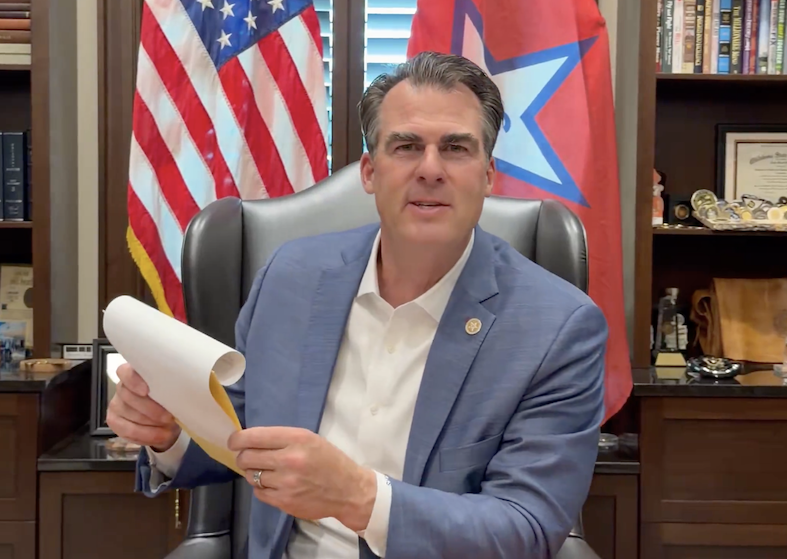
Oklahoma – Oklahoma Gov. Kevin Stitt is calling a federal appeals court decision a victory for the state’s jurisdiction, arguing that the landmark McGirt ruling should not be extended beyond its narrow criminal-law context to areas such as taxation, traffic enforcement and environmental regulation.
In a statement released Oct. 20, Stitt welcomed the U.S. Court of Appeals for the Tenth Circuit’s decision upholding the Environmental Protection Agency’s approval of Oklahoma’s authority to administer certain federally approved environmental programs across the state, including on tribal lands.
“Today’s ruling is a clear victory for all four million Oklahomans, the state of Oklahoma, and the rule of law,” Stitt said.
The case, Pawnee v. EPA, involved a challenge by the Pawnee Nation to the EPA’s May 2025 approval of Oklahoma’s request to extend more than two dozen EPA-approved environmental programs across Oklahoma. The court issued its decision on Oct. 16, rejecting the tribe’s challenge and upholding the agency’s approval.
Stitt said the ruling supported his longstanding position that the U.S. Supreme Court’s 2020 decision in McGirt v. Oklahoma should not be interpreted as limiting Oklahoma’s authority across broad areas of civil and regulatory law.
“Since McGirt, I’ve warned that efforts to stretch that narrow criminal ruling into every area of law would tear our state apart,” Stitt said. “McGirt does not erase Oklahoma’s civil, tax, or environmental authority.”
The ruling followed years of disputes over whether Oklahoma could extend its environmental regulatory authority into areas recognized as Indian country following the Supreme Court’s McGirt v. Oklahoma decision.
In 2020, the Supreme Court ruled in McGirt that Congress had not disestablished the Muscogee (Creek) Nation’s reservation, a decision with major consequences for criminal jurisdiction in eastern Oklahoma. The ruling prompted broader disputes over the boundaries of state and tribal authority, although the environmental case involved a separate federal law and a different legal question.
According to reporting by KOSU, the Tenth Circuit ruled 2-1 in favor of the EPA’s approval, allowing Oklahoma to administer the environmental programs on tribal lands covered by the decision. The case centered on a provision included in a 2005 transportation funding law that allows Oklahoma to seek federal approval to administer environmental programs in Indian country.
The provision, sometimes called the “Midnight Rider,” had remained unused for years before Oklahoma sought to invoke it after the McGirt decision expanded the legal significance of tribal reservations across much of eastern Oklahoma.
The EPA initially approved Oklahoma’s request in 2020 but later withdrew its decision to allow additional consultation with tribal nations. In May 2025, the agency approved the request again, removing a condition that required engagement with tribes. The Pawnee Nation challenged that approval, arguing that the provision had expired and that the EPA should have imposed safeguards and made additional determinations concerning the state’s environmental programs.
The court rejected the Pawnee Nation’s challenge, concluding that the provision remained in effect and that the EPA had acted within its authority when approving Oklahoma’s request. The ruling also found that the law did not require the agency to impose additional conditions on the approval.
However, the decision was not unanimous. One judge dissented, arguing that the EPA should have retained the authority to impose conditions protecting tribal interests and criticizing the effect of allowing the state to take over environmental program administration without such safeguards.
The Pawnee Nation responded to the ruling in an Oct. 21 statement, saying it was disappointed but that the decision’s direct impact on the tribe would be limited. The tribe’s response highlighted the continuing disagreement over the extent to which Oklahoma can exercise regulatory authority on tribal lands and what role tribal governments should have in those decisions.
Stitt, meanwhile, said the ruling would allow Oklahoma to continue protecting its natural resources while defending the state’s jurisdiction.
“Oklahomans cherish our natural resources and will continue to protect them, but the people of Oklahoma can be confident that ongoing challenges to the state’s jurisdiction will not be successful,” he said.
The Tenth Circuit’s decision does not eliminate the EPA’s ongoing oversight of Oklahoma’s environmental programs. The court noted that the agency retains its ordinary responsibilities under federal environmental laws to monitor state-administered programs and ensure they comply with applicable requirements.
The ruling marks a significant development in Oklahoma’s ongoing legal disputes over state and tribal authority following McGirt. It upholds the EPA’s approval for Oklahoma to administer the covered environmental programs on tribal lands, while leaving broader disagreements over tribal sovereignty and regulatory oversight at the center of the debate.
Oklahoma Gov. Stitt responds to federal court ruling, says state’s authority over taxes, traffic laws and environmental regulations is not erased by McGirt