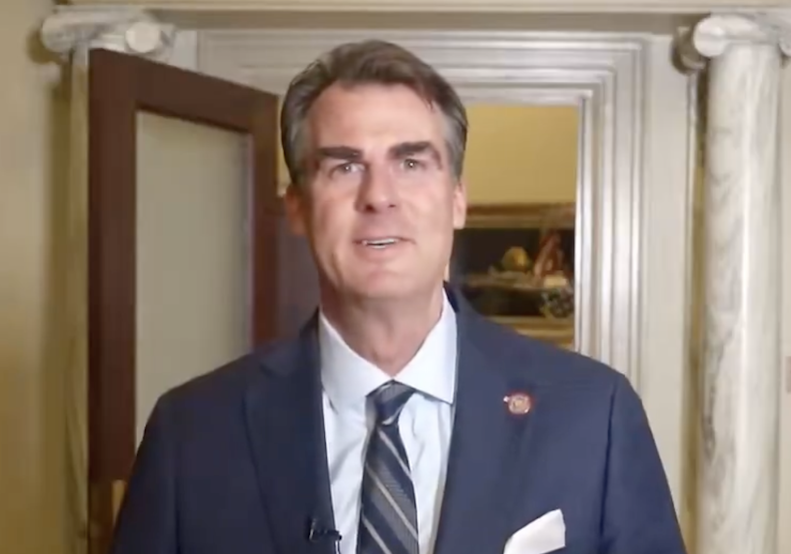
Lawton, OK – Governor Kevin Stitt said the final day of Oklahoma’s legislative session delivered a clear message that the state is ready for reform, accountability, and consolidation across hundreds of boards and commissions.
In a statement released after Sine Die, the governor pointed to legislative outcomes involving multiple vetoes and reform proposals tied to the structure of state government. Stitt said lawmakers failed to override his veto of House Bill 3320, which would have permanently extended 39 boards and commissions by removing statutory sunset dates.
“Sunset dates exist for a reason,” Stitt said. “They force government to justify its existence, prove its value to taxpayers, and remain accountable to the people.”
The governor argued that permanently extending boards and commissions without additional reform would reduce accountability and limit opportunities for restructuring. He said the state should instead pursue consolidation and efficiency before continuing or expanding government entities.
Several additional veto override efforts also failed during the session, including legislation that would have extended sunset dates for multiple boards and councils. These included the Oklahoma Educational Television Authority measures (SB 1461 and HB 3320), advisory councils under the Department of Environmental Quality (HB 3007), the Oklahoma Advisory Council on Indian Education (HB 3006 and SB 1721), and the Board of Chiropractic Examiners (HB 3003).
Stitt said these outcomes reflect ongoing debates over the size and structure of state government, particularly as Oklahoma operates with more than 400 boards and commissions.
“Future leaders have a real opportunity to finish the job,” Stitt said. “Oklahoma does not need hundreds of boards and commissions operating with little accountability to voters. We need a leaner, more efficient government that protects taxpayers, reduces duplication, and ensures every board and commission serves a clear public purpose.”
Despite the failed veto overrides, the governor highlighted several actions taken during the session that aligned with his broader reform agenda. According to his office, he signed legislation eliminating or repealing multiple boards and programs, including the Hospital Advisory Council, the Workers’ Compensation Advisory Council, the Low Carbon Energy Initiative Board, the Health Care Workers and Educators Assistance Program, the Health Care Workforce Resources Act, and the Alzheimer-Dementia Disclosure Act Advisory Council.
Stitt said these changes represent progress toward reducing duplication and streamlining state government functions, though he emphasized that more work remains.
“It is about making government work better for the people who pay for it,” he said. “We made progress this session, but there is more work to do.”
The governor’s comments highlight an ongoing political debate in Oklahoma over the size of state government, with supporters arguing that consolidation improves efficiency and critics warning that rapid reductions in boards and commissions could reduce oversight and public representation.
As the session concluded, Stitt framed the outcome as part of a broader effort to reshape state government operations and push for continued reform in future legislative cycles.
For a full list of Governor Stitt’s 2026 vetoes and the reasoning behind each one, visit the Governor’s veto website.